We have compiled a list of manufacturers, distributors, product information, reference prices, and rankings for Simulation Software.
ipros is IPROS GMS IPROS One of the largest technical database sites in Japan that collects information on.

Simulation Software(cfd) - List of Manufacturers, Suppliers, Companies and Products | IPROS GMS

Last Updated: Aggregation Period:Jan 21, 2026~Feb 17, 2026
This ranking is based on the number of page views on our site.

Simulation Software Product List

1~30 item / All 46 items

Displayed results

[Data] CFD Software - Simulation of Plastic Technology

We are publishing the flow of CFD simulations and the definition of geometry using photos!

This document introduces the CFD software plastic technology simulations from IANUS Corporation. It includes topics such as "Design of Plastic Processes Without CFD Simulation," "Flow of CFD Simulation," and "Definition of Geometry." Please take a moment to read it. [Contents] ■ IANUS Corporation - Business Overview ■ Design of Plastic Processes Without CFD Simulation ■ Design of Plastic Processes With CFD Simulation ■ Flow of CFD Simulation ■ CFD Simulation Rheology Model *For more details, please refer to the PDF document or feel free to contact us.

  • others
  • Simulation Software

Added to bookmarks

Bookmarks list

Bookmark has been removed

Bookmarks list

You can't add any more bookmarks

By registering as a member, you can increase the number of bookmarks you can save and organize them with labels.

Free membership registration

CFD solution "Millennium M1"

Accelerating system development through simulations using multiphysics, AI, and digital twins.

The HW/SW acceleration digital twin solution "Millennium M1" is a CFD solution for system design and analysis using multiphysics. It includes our high-fidelity CFD software stack, enabling a significant reduction in turnaround time even for complex mechanical systems. 【Features】 ■ Available for both cloud and on-premises use ■ Achieves ultra-fast throughput with a combination of GPU-resident CFD solvers and dedicated GPUs ■ Provides linear scalability *Please note that the materials are in English, so feel free to contact us for more details.

Added to bookmarks

Bookmarks list

Bookmark has been removed

Bookmarks list

You can't add any more bookmarks

By registering as a member, you can increase the number of bookmarks you can save and organize them with labels.

Free membership registration

[Case Study] Torque Reduction of Centrifugal Fans through CFD and Automatic Optimization

Exploring centrifugal fan design without relying on trial and error! An efficient approach through CFD analysis and optimization!

In this case study, we will introduce our efforts to reduce torque using CFD analysis and automatic optimization focused on centrifugal fans. This will provide an effective solution to the following background and challenges: - We want to quickly find promising shape proposals that meet performance requirements during the initial design phase. - We want to understand designs that can reduce torque while maintaining pressure performance. - We want to quantitatively understand which design variables contribute to performance. For details on the optimization approach, optimization results, and insights useful for design decisions, please download the PDF.

  • Thermo-fluid analysis
  • 3D CAD
  • Other analyses
  • Simulation Software

Added to bookmarks

Bookmarks list

Bookmark has been removed

Bookmarks list

You can't add any more bookmarks

By registering as a member, you can increase the number of bookmarks you can save and organize them with labels.

Free membership registration

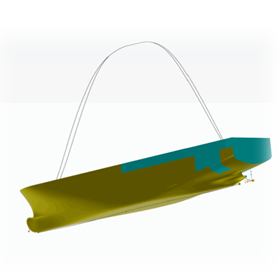
AIPOD: Optimization of Ship Performance

The selection of a rational optimization strategy is particularly important! The model in question is the KCS hull form.

In ship shape optimization, considering the analysis time and computational resource costs for a single case, engineers need to find an optimal design solution with as few computational cases as possible. Therefore, the selection of a rational optimization strategy becomes particularly important. This article introduces ship optimization using the general-purpose optimization platform AIPOD. *For more details, you can view the related links. For further information, please download the PDF or feel free to contact us.*

  • 船舶の性能最適化3.png
  • Thermo-fluid analysis
  • 3D CAD
  • Other analyses
  • Simulation Software

Added to bookmarks

Bookmarks list

Bookmark has been removed

Bookmarks list

You can't add any more bookmarks

By registering as a member, you can increase the number of bookmarks you can save and organize them with labels.

Free membership registration

Car aerodynamic simulation software ELEMENTS

HELYX environment that puts OpenFOAM into practical use

The aerodynamic simulation software ELEMENTS, developed by Streamline Solutions in the United States, is an application compatible with open-source solvers that holds great potential. (Streamline Solutions is a joint venture between the UK-based Engys and the US-based Auto Research Center (ARC)). ELEMENTS is a groundbreaking solution that combines ARC's wind tunnel testing and analysis techniques specialized for vehicles with Engys's open-source utilization, CFD, FEA, design optimization, and adjoint technology.

  • Thermo-fluid analysis
  • Simulation Software

Added to bookmarks

Bookmarks list

Bookmark has been removed

Bookmarks list

You can't add any more bookmarks

By registering as a member, you can increase the number of bookmarks you can save and organize them with labels.

Free membership registration

CFD optimization through integration with AnsysCFD.

An appropriate CAD tool is needed to ensure the generation of various model variations to be analyzed in the automation process!

Ansys CFD tools such as Fluent and CFX receive strong support from engineers for evaluating fluid dynamic behavior in design, along with various options and tools used for mesh creation. These tools provide valuable information and insights regarding the performance to be evaluated. Moreover, they enable automated optimization and design exploration workflows that include CFD. In addition to improving design and shortening development time and design cycles, these tools significantly enhance the development process by increasing information about the impact of various design variables on performance (product behavior) during the initial design phase, where there is a high degree of freedom in decision-making. *For more details, you can view the related links. For more information, please download the PDF or feel free to contact us.*

  • 【CAESES】AnsysCFDとの連携によるCFD最適化2.png
  • 【CAESES】AnsysCFDとの連携によるCFD最適化3.png
  • 【CAESES】AnsysCFDとの連携によるCFD最適化4.png
  • 【CAESES】AnsysCFDとの連携によるCFD最適化5.png
  • 【CAESES】AnsysCFDとの連携によるCFD最適化6.png
  • 【CAESES】AnsysCFDとの連携によるCFD最適化7.png
  • 【CAESES】AnsysCFDとの連携によるCFD最適化8.png
  • 【CAESES】AnsysCFDとの連携によるCFD最適化9.png
  • Structural Analysis
  • Other CAD
  • Simulation Software

Added to bookmarks

Bookmarks list

Bookmark has been removed

Bookmarks list

You can't add any more bookmarks

By registering as a member, you can increase the number of bookmarks you can save and organize them with labels.

Free membership registration

Fidelity CharLES

High-speed LES simulation for challenging design problems

The Fidelity CharLES solver is the industry's first high-fidelity computational fluid dynamics (CFD) solver, expanding large eddy simulation (LES) to a wide range of engineering applications such as aerospace, automotive, and turbomachinery. Designed to tackle challenging computational fluid dynamics problems, this solver accurately predicts traditional complex issues in CFD related to aeroacoustics, aerodynamics, combustion, heat transfer, and multiphase flow. While high-fidelity LES simulations offer world-class accuracy and stability, they can consume thousands of CPU cores for days in a single simulation, which has traditionally limited the practical application of this technology due to cost concerns. The Fidelity CharLES software reduces the time required for LES simulations from days to hours by leveraging both CPU and GPU capabilities. The solver is optimized to consume as little memory as possible.

  • fidelity-charles-voronoi-meshing.png
  • supersonic-jet-military-style-nozzle.jpg
  • fidelity-charles-multiphase.jpg
  • Other CAD related software
  • Simulation Software

Added to bookmarks

Bookmarks list

Bookmark has been removed

Bookmarks list

You can't add any more bookmarks

By registering as a member, you can increase the number of bookmarks you can save and organize them with labels.

Free membership registration

Optimization of vessels

The total hull resistance obtained after parametric modeling, CFD analysis, and optimization processing was reduced by 2 to 3%.

CAESES's hull parametric modeling, when combined with CFD software, facilitates the study of hull shapes (reducing resistance) and enables the design to optimize hull performance. The hull shape, particularly the forward shape, has a significant impact on hull resistance, making shape optimization crucial. With CAESES, hulls can be easily parameterized, allowing for straightforward adjustments to the hull shape. By generating multiple shape patterns and combining them with analysis tools, designs can be optimized according to various optimization objectives. *For more detailed information, please refer to the related links. For further details, you can download the PDF or feel free to contact us.*

  • 6370199815693877095633449.gif
  • 6370199819867683684716010.jpg
  • Software (middle, driver, security, etc.)
  • Other analyses
  • Simulation Software

Added to bookmarks

Bookmarks list

Bookmark has been removed

Bookmarks list

You can't add any more bookmarks

By registering as a member, you can increase the number of bookmarks you can save and organize them with labels.

Free membership registration

Optimization of the shape of the volute and diffuser of a centrifugal compressor.

For shape creation, we use CAESES, and for mesh model creation and CFD analysis, we use products from NUMECA!

At the Technical University of Darmstadt in Germany (Institute of Gas Turbines and Aerospace Propulsion), research was conducted on the automatic optimization of the volute of centrifugal compressors and vane diffusers. This project was carried out in collaboration with NUMECA, a German company, and Kompressorenbau Bannewitz GmbH (KBB), a turbo machinery manufacturer. CAESES was used for shape creation, while NUMECA's products were utilized for mesh model creation and CFD analysis. In CAESES, a parametric model was created that allowed for variations in the cross-sectional shape and area distribution of the volute. For the diffuser, a non-axisymmetric design was implemented, enabling quick shape transformations by varying the misalignment angle, blade twist, chord length, pitch, and rotation through a parametric model. *For more detailed information, please refer to the related links. You can download the PDF for more details or feel free to contact us.*

  • 遠心圧縮機のボリュートとディフューザーの形状最適化2.png
  • Structural Analysis
  • Other analysis software
  • Simulation Software

Added to bookmarks

Bookmarks list

Bookmark has been removed

Bookmarks list

You can't add any more bookmarks

By registering as a member, you can increase the number of bookmarks you can save and organize them with labels.

Free membership registration

Optimization of the poppet valve

This article explains the design system based on the collaboration between the CFD solver SimericsMP and CAESES, based on actual research conducted!

The Italian company OMIQ SRL, which sells software, conducted research on an automatic design system using the poppet valve of high-pressure pumps developed by the Danish machinery manufacturer Danfoss. In this case, we will introduce the design system that integrates the CFD solver SimericsMP with CAESES based on the research that was actually conducted. The issue in this case is that the poppet valve exhibits unacceptable unstable behavior during operation. It was found that when the poppet valve attempts to open to its maximum displacement (27.5 mm), the instability of the flow increases, resulting in a decrease in pressure on the poppet valve, ultimately preventing the valve from fully opening (closing to about 6 mm remaining). This unstable phenomenon was verified through unsteady analysis using SimericsMP. *For more detailed information, please refer to the related link. For further details, you can download the PDF or feel free to contact us.*

  • ポペットバルブの最適化2.png
  • ポペットバルブの最適化3.gif
  • ポペットバルブの最適化4.gif
  • ポペットバルブの最適化5.gif
  • ポペットバルブの最適化6.gif
  • ポペットバルブの最適化7.png
  • ポペットバルブの最適化8.png
  • ポペットバルブの最適化9.png
  • ポペットバルブの最適化10.png
  • valve
  • Simulation Software

Added to bookmarks

Bookmarks list

Bookmark has been removed

Bookmarks list

You can't add any more bookmarks

By registering as a member, you can increase the number of bookmarks you can save and organize them with labels.

Free membership registration

Torque converter shape optimization

CAESES provides beneficial results across various fields, regardless of the products in question!

A torque converter for automobiles is a type of fluid coupling used in vehicles equipped with automatic transmissions to transmit rotational force from the engine to the drive shaft. Designers of torque converters work to minimize cavitation within the device and ensure good flow behavior of the transmission oil, aiming to maximize efficiency and torque ratio at high speeds. CAESES enables the modeling of such complex shapes and can build an optimization system that incorporates shape data into analysis software. By connecting CFD analysis software and proprietary CFD codes to CAESES, it analyzes flow behavior for each designed shape during optimization calculations and provides users with the optimal shape based on constraints. *For more detailed information, please refer to the related links. For further details, feel free to download the PDF or contact us.*

  • 13-2.png
  • Other analysis software
  • Simulation Software

Added to bookmarks

Bookmarks list

Bookmark has been removed

Bookmarks list

You can't add any more bookmarks

By registering as a member, you can increase the number of bookmarks you can save and organize them with labels.

Free membership registration

[Case Study] Sankikogyo Co., Ltd.

Expressing 3D results of CFD simulations in real space! Achieving highly expressive presentations.

We would like to introduce a case study of the implementation of the MR (Mixed Reality) system 'MREAL' at Sankei Kogyo Co., Ltd. The company's requests included wanting to "visualize the results of CFD (Computational Fluid Dynamics) simulations, which are essential for air conditioning design, in a realistic manner," and "to communicate effectively with those who do not have expertise in air conditioning design to reach accurate conclusions." After the implementation, they reported that "we were able to visualize the invisible air flow and temperature distribution in real space," and "this led to a better understanding accompanied by a sense of reality, enabling accurate communication and speedy decision-making with the client." [Case Overview] ■ Implementing Company: Sankei Kogyo Co., Ltd. ■ Main Businesses: Building air conditioning and sanitation business, industrial air conditioning business, electrical business, smart building solutions business, facility systems business, mechanical systems business, environmental systems business, real estate business, technical research institute. *For more details, please refer to the PDF document or feel free to contact us.

Added to bookmarks

Bookmarks list

Bookmark has been removed

Bookmarks list

You can't add any more bookmarks

By registering as a member, you can increase the number of bookmarks you can save and organize them with labels.

Free membership registration

External aerodynamic analysis - supersonic CFD Altair ultraFluidX

A simulation tool that predicts the aerodynamic characteristics of passenger cars, large vehicles, buildings, and environments at super high speeds.

ultraFluidX is a simulation tool that predicts the aerodynamic characteristics of passenger cars, large vehicles, buildings, and environments at ultra-high speeds. By using ultraFluidX, highly complex aerodynamic simulations can be completed overnight on a single server. From ground transportation vehicles, architecture, engineering, and construction structures to individual applications, designers can use ultraFluidX to understand fluid dynamics, explore innovative structures, improve efficiency, enhance user comfort, and deliver safe projects on time. <Benefits of Implementation> - Execution of high-fidelity transient analysis - Short turnaround time - Significant cost reduction

  • Thermo-fluid analysis
  • Simulation Software

Added to bookmarks

Bookmarks list

Bookmark has been removed

Bookmarks list

You can't add any more bookmarks

By registering as a member, you can increase the number of bookmarks you can save and organize them with labels.

Free membership registration

Propeller optimization using machine learning

The main objective of the contest was to design a propeller that could achieve maximum efficiency at a wide range of operating speeds.

In propeller design, achieving optimal efficiency and performance is extremely important. Recently, by effectively combining AI and CFD, we were able to win an online propeller design contest hosted by a popular YouTube creator. In this contest, we were able to create two high-performance propellers that demonstrated excellent efficiency using "CAESES" and "AirShaper." *For more details, you can view the related links. For more information, please download the PDF or feel free to contact us.*

  • 機械学習によるプロペラ最適化2.gif
  • 機械学習によるプロペラ最適化3.gif
  • 機械学習によるプロペラ最適化4.gif
  • 機械学習によるプロペラ最適化5.gif
  • 機械学習によるプロペラ最適化6.gif
  • 機械学習によるプロペラ最適化7.png
  • 機械学習によるプロペラ最適化8.png
  • 機械学習によるプロペラ最適化9.png
  • 機械学習によるプロペラ最適化10.png
  • Image analysis software
  • Structural Analysis
  • Simulation Software

Added to bookmarks

Bookmarks list

Bookmark has been removed

Bookmarks list

You can't add any more bookmarks

By registering as a member, you can increase the number of bookmarks you can save and organize them with labels.

Free membership registration

Optimization of the turbine blade shape of the turbocharger.

Introduction to the combination of CFD and stress analysis, as well as scallop turbine wheels!

FRIENDSHIP SYSTEMS, the developer of CAESES, has collaborated with MTU and Darmstadt University of Technology to develop a robust and variable turbine wheel geometry for turbochargers. The research, called Project GAMMA ("Efficient Gas Engines for Maritime Applications of the Next Generation"), aims to develop and prepare new technologies and interactions within the system for LNG/natural gas, which serves as fuel for efficient ship propulsion systems. *For more detailed information, please refer to the related links. You can download the PDF for more details or feel free to contact us.*

  • ターボチャージャーのタービンブレード形状最適化2.png
  • ターボチャージャーのタービンブレード形状最適化3.png
  • ターボチャージャーのタービンブレード形状最適化4.png
  • ターボチャージャーのタービンブレード形状最適化5.png
  • ターボチャージャーのタービンブレード形状最適化6.png
  • ターボチャージャーのタービンブレード形状最適化7.png
  • ターボチャージャーのタービンブレード形状最適化8.png
  • Structural Analysis
  • Turbine
  • Simulation Software

Added to bookmarks

Bookmarks list

Bookmark has been removed

Bookmarks list

You can't add any more bookmarks

By registering as a member, you can increase the number of bookmarks you can save and organize them with labels.

Free membership registration

Cast-Designer

Simulation software that integrates "concept design" and "analysis" for die-cast products.

"Cast-Designer" is a simulation software that analyzes die-cast products. It supports high-pressure and low-pressure die casting, gravity, investment, tilt, and more. Furthermore, it not only offers analysis functions but also provides features for design planning, enabling quick and easy execution of everything from die-casting system design to analysis.

  • simulator
  • Thermo-fluid analysis
  • Stress Analysis
  • Simulation Software

Added to bookmarks

Bookmarks list

Bookmark has been removed

Bookmarks list

You can't add any more bookmarks

By registering as a member, you can increase the number of bookmarks you can save and organize them with labels.

Free membership registration

Hydrodynamic performance of underwater lift surfaces in high-speed navigation.

The optimal solver for hydrodynamic investigation of waterborne lift surfaces.

Using Navier-Stokes-based CFD simulations, two standard problems were studied, and the hydrodynamics of submerged lift surfaces were investigated. (1) Flow around a three-dimensional submerged lift surface with an elliptical shape and a constant camber wing cross-section. (2) Flow around a two-dimensional symmetric wing cross-section. The dependence of the resulting hydrodynamic loads on changes in velocity and angle of attack was examined under fully submerged conditions that allowed for the occurrence of cavitation. A comparison of results obtained from numerical simulations and measurements from experiments conducted in a pressurized test tank facility was presented.

  • img24.jpg
  • img25.jpg
  • img27.jpg
  • img29.jpg
  • img14.jpg
  • img15.jpg
  • img19.jpg
  • img33.jpg
  • img34.jpg
  • Thermo-fluid analysis
  • Simulation Software

Added to bookmarks

Bookmarks list

Bookmark has been removed

Bookmarks list

You can't add any more bookmarks

By registering as a member, you can increase the number of bookmarks you can save and organize them with labels.

Free membership registration

Optimization of globe valve shape

The purpose is to improve and investigate the performance of globe valves, connecting the cloud-based CFD solver SimScale with CAESES!

CAESES has been conducting optimization calculations for various types of valves and has implemented projects in collaboration with various companies. In this context, we would like to introduce one of the newly conducted projects, "Shape Optimization of a Globe Valve." This project was carried out in cooperation with GEMÜ Gebr. Müller Apparatebau, a German valve manufacturer and a global company specializing in aseptic valves, and SimScale, a leading engineering simulation company. *For more detailed information, please refer to the related links. You can download the PDF for more details or feel free to contact us.*

  • グローブバルブの形状最適化2.png
  • グローブバルブの形状最適化3.png
  • グローブバルブの形状最適化4.png
  • グローブバルブの形状最適化5.png
  • グローブバルブの形状最適化6.png
  • グローブバルブの形状最適化7.png
  • グローブバルブの形状最適化8.png
  • Structural Analysis
  • Other CAD
  • valve
  • Simulation Software

Added to bookmarks

Bookmarks list

Bookmark has been removed

Bookmarks list

You can't add any more bookmarks

By registering as a member, you can increase the number of bookmarks you can save and organize them with labels.

Free membership registration

Optimization of Marine Propeller Blade Shape Using OpenFOAM

The blades used for calculations can be created using the "Generic Blade" feature of CAESES.

One of the advantages of CAESES is its optimization design through an automation system connected to CFD software. This article introduces the blade shape optimization of marine propellers using OpenFOAM and CAESES, which is currently in use. In CAESES, in addition to methods for designing parametric 2D and 3D models, it is also possible to connect with various external software. *For more details, you can view the related links. For further information, please download the PDF or feel free to contact us.*

  • 6377102696005262328629436.png
  • 6377102709000600286261130.png
  • 6377102733181822253651802.png
  • 6377102792644412105023850.png
  • 6377102940461506159267580.png
  • Software (middle, driver, security, etc.)
  • Other analyses
  • Simulation Software

Added to bookmarks

Bookmarks list

Bookmark has been removed

Bookmarks list

You can't add any more bookmarks

By registering as a member, you can increase the number of bookmarks you can save and organize them with labels.

Free membership registration

Optimization Case of Centrifugal Compressor Impeller Using CAESES

By constructing a parametric model, it is also possible to optimize the entire compressor model!

Centrifugal compressors are compact yet feature a high pressure ratio, and they are widely used in systems in the fields of aircraft and marine vessels. Impeller design is a crucial design aspect of centrifugal compressors and has a significant impact on compressor performance. In this case, we conducted automatic performance optimization using CAESES combined with CFD tools on an existing centrifugal compressor impeller model. *For more detailed information, please refer to the related links. For further details, you can download the PDF or feel free to contact us.*

  • CAESESによる遠心圧縮機インペラの最適化事例2.png
  • CAESESによる遠心圧縮機インペラの最適化事例3.png
  • CAESESによる遠心圧縮機インペラの最適化事例4.png
  • CAESESによる遠心圧縮機インペラの最適化事例7.gif
  • CAESESによる遠心圧縮機インペラの最適化事例8.gif
  • CAESESによる遠心圧縮機インペラの最適化事例9.gif
  • CAESESによる遠心圧縮機インペラの最適化事例10.gif
  • Centrifugal concentrator
  • Simulation Software

Added to bookmarks

Bookmarks list

Bookmark has been removed

Bookmarks list

You can't add any more bookmarks

By registering as a member, you can increase the number of bookmarks you can save and organize them with labels.

Free membership registration

Optimization of unmanned aerial vehicles

This paper introduces efforts utilizing optimization algorithms in the design of unmanned aerial vehicles (UAVs), which have seen increasing demand in recent years.

UAVs are controlled by a wireless remote control device and an embedded program control device, and they are classified into various forms such as unmanned fixed-wing aircraft, unmanned vertical take-off and landing vehicles, unmanned airships, unmanned helicopters, and unmanned multi-rotor aircraft. Their applications are wide-ranging, including aerial photography, agriculture, disaster relief, infectious disease monitoring, mapping, journalism, and film and television production. For optimization, a fully parametric blade model targeting the wing shape of unmanned aerial vehicles is created, and by integrating automated design with CFD analysis, appropriate design proposals are identified. *For more detailed information, please refer to the related links. For further inquiries, feel free to download the PDF or contact us.*

  • 6368134296768734423348389.gif
  • 6368134304120416188922970.gif
  • 6368134306668745824303331.gif
  • 6368134309159499504729036.gif
  • 6368134311032798685771560.gif
  • Other analyses
  • Simulation Software

Added to bookmarks

Bookmarks list

Bookmark has been removed

Bookmarks list

You can't add any more bookmarks

By registering as a member, you can increase the number of bookmarks you can save and organize them with labels.

Free membership registration

Design and Optimization of VOITH Linear Jet

Maintains high efficiency across the entire speed range of the vessel. Reduces cavitation, noise, and vibration.

The VOITH company's linear jet design, which is a challenging ship system characterized by complex shape features, combinations of multiple parts, and large-scale CFD calculation models, provides high customer satisfaction products by establishing and operating a fully automated design system using CAESES. The VOITH Linear Jet (VLJ) combines the simplicity of a propeller with the high-speed performance of a water jet. One of the most important challenges in the design of this product is to delay the occurrence of cavitation while maintaining high efficiency over a wide operating range. *For more detailed information, please refer to the related links. For more details, you can download the PDF or feel free to contact us.*

  • 6367400594009132907391666.png
  • 6367400594166870691875978.png
  • 6367400594193462921562180.png
  • 6367400594226875084761708.png
  • 6367400594276642776675621.png
  • 6367400594304365044889241.gif
  • Software (middle, driver, security, etc.)
  • Other analyses
  • Simulation Software

Added to bookmarks

Bookmarks list

Bookmark has been removed

Bookmarks list

You can't add any more bookmarks

By registering as a member, you can increase the number of bookmarks you can save and organize them with labels.

Free membership registration

Tire tread pattern optimization

A system for automatic optimization has been built using CAESES and commercial CFD analysis tools, resulting in significant improvements to the tire tread pattern!

The development of advanced automotive systems such as electric vehicles, autonomous driving systems, and safety enhancement systems will significantly increase the number of electronic devices added to the vehicle body, including sensors, radars, and cameras. It is crucial for these devices to function reliably while minimizing exposure to water to prevent damage and corrosion. One effective approach to achieve this is to reduce water splashes on the vehicle's body and underbody. This case study introduces simulation-driven optimization to investigate the impact of tire tread patterns on water splashes. *For more detailed information, please refer to the related links. You can download the PDF for more details or feel free to contact us.*

  • 10-2.png
  • 10-3.png
  • 10-5.png
  • 10-6.png
  • 10-7.png
  • 10-8.png
  • Other analysis software
  • Simulation Software

Added to bookmarks

Bookmarks list

Bookmark has been removed

Bookmarks list

You can't add any more bookmarks

By registering as a member, you can increase the number of bookmarks you can save and organize them with labels.

Free membership registration

PyroSim・FDS Experience Seminar [Free Event]

Expanding the possibilities of FDS using supercomputers

- This is an experiential seminar on the Fire Dynamics Simulator (FDS) developed by the National Institute of Standards and Technology (NIST) and its solver, PyroSim. - FDS uses computational fluid dynamics (CFD), making its approach applicable to fires of various scales, from stoves to oil storage tanks. It can also be applied to problems that do not involve fires, such as building ventilation. - In this seminar, along with the experiential session, we will also introduce the foundation with the cooperation of the Public Interest Incorporated Foundation for the Promotion of Computational Science, and there will be a tour of the FOCUS supercomputer and the K computer.

  • Thermo-fluid analysis
  • Simulation Software

Added to bookmarks

Bookmarks list

Bookmark has been removed

Bookmarks list

You can't add any more bookmarks

By registering as a member, you can increase the number of bookmarks you can save and organize them with labels.

Free membership registration

Design and optimization of valves

The procedure explored using CAESES achieved a reduction in working time from several months to several days!

The optimization of valve design is one of many optimization targets, and by appropriately automating the design change process using CAESES and analyzing the number of implementation cases generated by the CFD solver, it is possible to significantly shorten the time to commercialization while exploring truly suitable designs under constraints. A valve is a device that opens, closes, or partially obstructs various passages to control, direct, or adjust the flow of fluid. In an open valve, fluid flows from high pressure to low pressure. Typically, the main objective of valve optimization is to adjust the flow rate passing through the valve at a specified pressure loss. This is often expressed as a flow coefficient, which serves as a relative measure of flow efficiency. *For more detailed information, please refer to the related links. For more details, you can download the PDF or feel free to contact us.*

  • バルブの設計と最適化2.jpg
  • バルブの設計と最適化3.gif
  • バルブの設計と最適化4.gif
  • バルブの設計と最適化5.gif
  • バルブの設計と最適化7.gif
  • バルブの設計と最適化8.gif
  • バルブの設計と最適化9.gif
  • バルブの設計と最適化10.gif
  • バルブの設計と最適化11.gif
  • valve
  • Simulation Software

Added to bookmarks

Bookmarks list

Bookmark has been removed

Bookmarks list

You can't add any more bookmarks

By registering as a member, you can increase the number of bookmarks you can save and organize them with labels.

Free membership registration

High performance and longevity of turbo machinery through retrofit optimization.

Notice of Webinar on June 22, 2021 (Tuesday) at 11 PM! You can learn how to use optimization tools.

The aging of machinery is a challenge for engineers. To maximize the lifespan of turbo machinery, minimize losses, and apply new technologies, upgrading flow paths through CFD simulation, optimizing blades, and designing seal leaks are very effective measures. Cadence Design Systems and Concepts NREC provide all the necessary tools to design extremely complex shapes and analyze them with high precision to optimize performance within constraints. In a 30-minute webinar, you can learn how to operate AxCent, OMNIS/Turbo, and the optimization kernel Minamo. [Content] ■ Calculate and analyze the performance of steam turbines ■ Generate parametric models with AxCent ■ Redesign turbines with new blades, flow paths, and seals through optimization *For more details, please refer to the related link page or feel free to contact us.

Added to bookmarks

Bookmarks list

Bookmark has been removed

Bookmarks list

You can't add any more bookmarks

By registering as a member, you can increase the number of bookmarks you can save and organize them with labels.

Free membership registration

Dimensional reduction of hull shape using principal component analysis in CAESES.

Introducing the dimensional reduction function based on the drag optimization of KCS ships!

To optimize the hydrodynamic performance of the hull using the parametric modeling and optimization software CAESES, we first extract design variables related to the deformation of the hull's variable geometry. By increasing the number of design variables in this process, we can obtain a wider variety of deformation shapes, which in turn increases the likelihood of achieving better hull design proposals. However, the number of computational cases required for simulations (such as CFD analysis) increases exponentially (recommended number of cases S = 2^N, where N is the number of design variables), leading to significantly larger computational and time costs. To address this issue, CAESES5 offers a dimensionality reduction feature based on Principal Component Analysis (PCA) methods. *For more detailed information, please refer to the related links. For further details, feel free to download the PDF or contact us.*

  • 主成分分析による船体形状の次元圧縮2.png
  • 主成分分析による船体形状の次元圧縮3.png
  • 主成分分析による船体形状の次元圧縮4.png
  • 主成分分析による船体形状の次元圧縮5.png
  • 主成分分析による船体形状の次元圧縮6.png
  • 主成分分析による船体形状の次元圧縮7.png
  • 主成分分析による船体形状の次元圧縮8.png
  • Other analyses
  • Simulation Software

Added to bookmarks

Bookmarks list

Bookmark has been removed

Bookmarks list

You can't add any more bookmarks

By registering as a member, you can increase the number of bookmarks you can save and organize them with labels.

Free membership registration

Optimization of Low-Density Polyethylene (LDPE) Autoclave Reactor

It is possible to shorten the development time of new polymer grades, optimize reactor design, and maximize production volume while maintaining polymer properties.

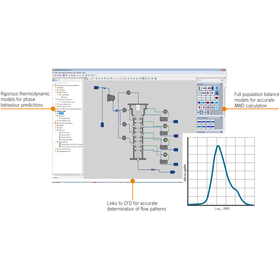
A new feature has been added to gPROMS ProcessBuilder: "Optimization of Low-Density Polyethylene (LDPE) Autoclave Reactors." 【Advanced Polymer Thermodynamics】 The SAFT equation of state represents molecules as chains of different functional groups, accurately modeling branching and capturing precise polymer characteristics across the entire molecular weight distribution (MWD). This approach is ideal for polymer modeling. 【Complete MWD Modeling】 Detailed kinetic modeling considers the fundamental polymerization reaction steps in chemically initiated free radical polymerization. This model uses a fixed pivot method to predict the time evolution of the entire molecular weight distribution (MWD). 【CFD-Linked Multi-Zone Approach】 Advanced process modeling provides a means to understand the impact of changes in operating conditions on the shape of the MWD. 【PSE Consulting Services】 Consulting services provided by a specialized team ensure the swift and high-quality execution of projects.

Added to bookmarks

Bookmarks list

Bookmark has been removed

Bookmarks list

You can't add any more bookmarks

By registering as a member, you can increase the number of bookmarks you can save and organize them with labels.

Free membership registration

GT-AutoLion

Simulation of battery performance due to heat and aging degradation.

AutoLion is a lithium-ion battery performance simulator developed by the U.S. company EC POWER. It allows you to efficiently predict the characteristics of lithium-ion batteries, such as discharge rate characteristics, discharge temperature characteristics, and current-voltage characteristics, using your personal computer. ○AutoLion-1D A standalone application that provides a virtual battery laboratory and includes all the necessary functions to build a one-dimensional simulator. ○AutoLion-ST An S-function for Simulink used for software-in-the-loop modeling and system design. ○AutoLion-3D A powerful three-dimensional modeling tool that integrates with commercial CFD applications for thermal management and safety predictions.

  • Company:IDAJ
  • Price:Other
  • Thermo-fluid analysis
  • Simulation Software

Added to bookmarks

Bookmarks list

Bookmark has been removed

Bookmarks list

You can't add any more bookmarks

By registering as a member, you can increase the number of bookmarks you can save and organize them with labels.

Free membership registration